A Winning Conversion Rate Optimization Strategy for Shopify

A solid conversion rate optimization strategy is all about turning more of your website visitors into actual customers. Think of it less as a mad dash for more traffic and more like a smart way to get the most value out of the people who are already on your site. It’s about converting those clicks into cash, without just throwing more money at ads.
Stop Guessing and Start Growing Your Shopify Sales

Getting traffic to your Shopify store is only half the battle, isn't it? The real frustration kicks in when those visitors click around, maybe even add something to their cart, and then just... leave. You're left staring at the analytics, wondering what on earth went wrong. Was it the price? The product photos? Something weird in the checkout? That kind of guesswork isn't just maddening—it's expensive.
Every single visitor who leaves your store empty-handed is a missed opportunity and, frankly, wasted ad spend. This guide is here to help you move beyond random tweaks and build a systematic conversion rate optimization strategy that turns more of that hard-earned traffic into real revenue.
The Problem with Random Changes
So many store owners fall into the "let's try this" trap. They'll change a button color one week, rewrite a product description the next, and maybe copy a layout they saw on a competitor's site, all in the hope that something will stick. The problem is, this approach is a shot in the dark. It lacks structure and almost never leads to meaningful, repeatable results.
When you're not working from a data-driven plan, you're flying blind. You can't figure out the why behind all those abandoned carts or low sales, which makes it impossible to find the right fix. This is exactly where a structured strategy makes all the difference.
A true optimization strategy is like a doctor's diagnostic process. You wouldn't accept a prescription without a proper examination, so why accept changes to your store without first understanding the underlying issues?
A Framework for Predictable Growth
This guide will walk you through a proven framework for finding and fixing the friction points in your customer journey. A methodical process helps you uncover the real reasons visitors aren't converting, which lets you build a laser-focused plan for improvement. The key pieces of this process are:
Data Analysis: Digging deeper than surface-level metrics to truly understand how people behave on your site.
User Research: Gathering qualitative feedback to get inside your customers' heads and learn their motivations and frustrations.
Prioritized Testing: Focusing your energy on the changes that will actually make the biggest impact on your bottom line.
A focused, results-driven plan like the Optise Shopify CRO Sprint is the bridge between just having traffic and having profitable growth. By following a clear roadmap, you can finally stop guessing and start building a more effective, customer-centric store that consistently turns visitors into loyal customers.
Let's start building your strategy.
What a Real CRO Strategy Actually Looks Like
Let's be honest. A lot of what passes for conversion rate optimization is just guesswork. People talk about testing button colors or changing a headline, hoping for a magic fix. That's not a strategy; it's throwing darts in the dark.
A real CRO strategy is like a doctor’s diagnostic process for your Shopify store. You wouldn't want a doctor prescribing medication without first understanding your symptoms, right? It’s the same here. A professional strategy is a systematic, data-driven investigation to understand the why behind what your customers do—and don't do.
This isn't about finding one secret tweak that doubles your revenue overnight. It's about building a repeatable system for growth. The goal is to stop guessing and start making informed decisions that methodically improve your store's performance over time.
The Three Pillars of a Professional Strategy
A solid CRO strategy is built on three core pillars. Think of them as different diagnostic tools that, when used together, give you a complete picture of your store's health. If you ignore one, you're flying blind.
Deep Data Analysis (The 'What'): This is your starting point. You dive into the hard numbers in tools like Google Analytics to see what is actually happening. Which pages are bleeding visitors? Where in the checkout funnel are people dropping off? This quantitative data points you toward the problem areas.
Qualitative User Research (The 'Why'): Once you know what is happening, you need to uncover why. This is where you get inside your customers' heads with tools like heatmaps, session recordings, and surveys. Watching a real person struggle to find your shipping policy in a session recording tells a story that a hundred charts never could.
Thorough Technical Audit (The 'How'): This pillar makes sure the fundamentals are solid. A slow-loading page, a broken link, or a clunky mobile experience can sabotage conversions before a visitor even sees your product. This audit ensures your store’s foundation is smooth and reliable for everyone.
A truly effective conversion rate optimization strategy combines these three pillars. It uses quantitative data to find a problem, qualitative research to understand its cause, and a technical audit to ensure the platform can support a solution.
From Diagnosis to Action
This is where it all comes together. Let's say your analytics show a 40% drop-off on your cart page. That’s the "what."
So, you start watching session recordings of people who abandon their carts. You notice a pattern: several users repeatedly click on the product thumbnail images, expecting to be taken back to the product page to double-check details. But nothing happens. That’s your "why."
Now you can build a powerful, evidence-based hypothesis: "By making the product thumbnails in the cart clickable links, we can reduce friction for users who want to review their items, which should decrease cart abandonment." This is a specific, testable idea born from a real user problem—not a random guess. To see more examples of this in practice, check out this practical guide to improving e--commerce conversion rates in fashion.
It’s also important to keep these numbers in perspective. Industry studies show that average e-commerce conversion rates hover between 2.6% and 3.2%. Knowing these benchmarks helps you set realistic goals. Some industries, like professional services, convert higher, while others, like B2B SaaS, often sit below 2%.
Ultimately, a real strategy is a continuous cycle: diagnose, hypothesize, experiment, and learn. It’s a methodical approach that replaces assumptions with evidence, leading to sustained, predictable growth for your Shopify store.
The Four Pillars of a High-Impact Shopify CRO Audit
A solid audit is the heart of any winning conversion rate optimization strategy. It’s the moment you stop guessing and start gathering real evidence, systematically hunting down all the hidden friction points that are quietly killing your sales. Instead of staring at a massive, vague problem, we break it down into four distinct, manageable pillars.
Think of it like inspecting a car engine. You don't just "fix the car"; you check the ignition, the fuel system, the electronics, and the exhaust. If one system is failing, the whole car sputters. By looking at each pillar methodically, you can pinpoint exactly what’s wrong and apply the right fix, turning a daunting task into a clear, actionable plan.
Pillar 1: Technical Performance and Page Speed
Before a shopper can fall in love with your products, your site has to work—and it has to be fast. The technical pillar is the non-negotiable foundation. If your store is slow, buggy, or broken on a phone, you’re losing people before they’ve even had a chance to see what you sell.
A one-second delay in page load isn't a minor annoyance; it’s a conversion killer. That's why modern CRO treats speed as a top priority. It's your digital first impression.
Here are the critical questions to ask:
How fast do your key pages load? We’re talking homepage, collection pages, and product pages. Test them on desktop and mobile.
Is the mobile experience truly seamless? Can you easily tap buttons? Is the text readable without pinching and zooming?
Are there any dead ends? Broken links and 404 errors destroy trust and stop a customer journey in its tracks.
Does everything actually work? Click every button, fill out every form, and use every filter. You'd be surprised what you find.
Pillar 2: User Experience and Navigation
Okay, so your site is technically sound. Now for the next question: can people easily find what they’re looking for? This pillar is all about making your store intuitive. A confusing user experience (UX) is the digital equivalent of a messy brick-and-mortar shop with cluttered aisles and no signage. Frustrated customers don't stick around.
Your job is to create a path of least resistance from the landing page to the checkout. The site's layout should feel so natural that shoppers don't even have to think about how to use it.
A great user experience is invisible. It guides the customer so effortlessly that the only thing they have to focus on is your products.
This part of the audit is all about clarity and simplicity. Walking through your site's flow like a brand-new customer can reveal some shocking roadblocks. Our complete guide to the conversion rate optimization audit offers a much deeper checklist to help you with this process.
Pillar 3: Persuasion and Messaging
This pillar digs into the why. Why should someone buy from you instead of your competitor down the digital street? Your messaging, value proposition, and social proof have to work together to build trust and create a genuine desire to buy. This is where you connect with visitors on an emotional level and convince them your product is the solution.
Strong persuasion is more than just listing features. It's about telling a story, highlighting real-world benefits, and calming customer anxieties. For instance, incorporating social proof like user-generated content (UGC) can make a huge difference. One study found that when visitors interacted with UGC, the purchase likelihood almost doubled, resulting in a staggering 102% lift in conversions.
Here’s what to look for:
Is your value proposition crystal clear on the homepage? Do people immediately get what you sell and why it’s better?
Are your product descriptions compelling? Do they focus on benefits, not just specs?
Are you using high-quality images and videos?
Is social proof (reviews, testimonials, etc.) easy to find and believable?
Pillar 4: Checkout and Cart Optimization
You've done all the hard work to get a customer to the finish line. Don't lose them now. The checkout is where your most motivated shoppers—the ones with credit cards in hand—can be lost to the smallest bit of friction.
Think of your checkout as the express lane at the grocery store: it needs to be fast, clear, and demand minimal effort. Surprise shipping costs, mandatory account creation, or a confusing form can send a buyer straight to the exit. This is the final, and most critical, leak to plug in your sales funnel.
By focusing on these four pillars, you create a comprehensive diagnostic framework that will guide your entire conversion rate optimization strategy from start to finish.
To get you started, here is a simplified checklist that breaks down the four pillars into actionable questions.
Shopify CRO Audit Checklist
This table provides a high-level overview to help you spot common opportunities for improvement across your Shopify store.
Pillar | Key Question to Ask | Example Metric to Check |
|---|---|---|
Technical Performance | Is my site fast and bug-free on all devices? | Page Load Time (via Google PageSpeed Insights) |
User Experience (UX) | Can users easily find products and navigate the site? | Bounce Rate on key landing pages |
Persuasion & Messaging | Is it obvious why customers should buy from me? | Add to Cart Rate |
Checkout & Cart | Is the checkout process simple, fast, and trustworthy? | Cart Abandonment Rate |
Use this checklist as your starting point. Going through each pillar will give you a much clearer picture of where your biggest wins are hiding.
How to Prioritize CRO Ideas for Maximum ROI
So, you’ve done your audit. And now you’re staring at a list of ideas so long it could scroll for days. You’ve got everything from a complete homepage overhaul to tweaking the color of a button. What now?
Here’s the hard truth: you can’t do it all at once. The secret to a killer conversion rate optimization strategy isn't just about collecting good ideas; it’s about executing the right ideas in the right order.
Trying to tackle everything is a surefire way to burn out your team and your budget. You need a system to cut through the noise and pinpoint the changes that will actually make you money. This is where a prioritization framework comes in. It’s the tool that turns your brainstorming chaos into a strategic, actionable roadmap.
Without a framework, you’ll end up chasing whatever idea seems most exciting or whichever team member shouts the loudest. That's not a strategy; it's a gamble.
Introducing the ICE Framework
One of the simplest and most effective ways to bring order to the chaos is the ICE scoring model. It’s a beautifully straightforward system that forces you to evaluate every idea against three core questions: what's the Impact, how Confident are we, and what’s the Effort?
This isn't about guesswork; it’s about bringing objective clarity to what is often a very subjective process.
Let's break down what each of these means for a Shopify store:
Impact: How big of a dent will this change make in your most important metrics, like conversion rate or Average Order Value (AOV)? A small tweak to your checkout page will almost always have a higher potential impact than redesigning a blog post, simply because it’s closer to the money.
Confidence: How sure are you that this will work? Your confidence score shouldn’t be based on a gut feeling. It needs to be backed by evidence—hard data from your audit, qualitative insights from user session recordings, or even established industry best practices.
Effort: Let's be real—how much time, money, and developer muscle is this going to take? A simple copy change on a button is a walk in the park. Rebuilding your entire site navigation from scratch? That’s a marathon.
You simply score each idea on a scale of 1-10 for each category, then average them out. The ideas with the highest ICE scores shoot straight to the top of your to-do list.
A prioritization framework like ICE transforms your optimization process from a series of random bets into a calculated strategy. It ensures you’re always working on the tasks most likely to move the needle.
Prioritization in Action: A Shopify Example
Let’s make this real. Imagine you're deciding between two very common ideas for your Shopify store: a full homepage redesign versus improving your abandoned cart emails.
Idea A: Homepage Redesign * Impact (6/10): A fresh homepage might look great and improve first impressions, but it’s pretty far from the "buy now" click. Its direct effect on sales is often less than a change made further down the funnel. * Confidence (3/10): This is where most redesigns fall flat. Unless you have rock-solid data proving your current homepage is actively turning customers away, you're mostly just hoping for the best. Big visual changes are notoriously unpredictable. * Effort (9/10): This is a beast of a project. It requires design, development, copywriting, and a ton of testing. It's a massive resource drain. * ICE Score: (6 + 3 + 9) / 3 = 6.0
Idea B: Optimize Abandoned Cart Emails * Impact (9/10): We're talking about customers who were this close to buying. They loaded up a cart and left. Nudging them back is pure profit recovery. Even a tiny improvement here has an immediate and direct impact on your bottom line. * Confidence (8/10): The data on this is overwhelming. Time and time again, powerful abandoned cart flows have been proven to boost sales. There are tons of proven strategies for abandoned cart emails that show just how effective this is. It's one of the most reliable plays in the e-commerce book. * Effort (3/10): Using modern email marketing tools, tweaking the copy, adding a better offer, or adjusting the timing of your emails is a relatively low-effort task. * ICE Score: (9 + 8 + 3) / 3 = 6.6
The numbers don't lie.
While the flashy homepage redesign feels like a big, exciting win, optimizing your abandoned cart sequence is the smarter, data-backed move. It promises a faster, more reliable return on your investment. This is exactly what a good prioritization framework does—it steers you away from vanity projects and toward the high-impact experiments that build real momentum for your store.
Building Your First 90-Day Shopify CRO Roadmap
So, you've got a prioritized list of conversion-boosting ideas. That's a great start, but ideas alone don't move the needle. A true conversion rate optimization strategy needs a timeline to turn those ideas into action and, ultimately, revenue.
Without a plan, even the most brilliant insights get buried under the daily grind of running a business. This is where we build a tangible, actionable roadmap—a 90-day sprint that breaks the massive task of optimization into focused, manageable chunks. Think of it less like a marathon and more like a series of well-planned sprints, each with its own finish line.
Phase 1: Deep-Dive Audit and Quick Wins (Days 1-30)
The first 30 days are all about building a solid foundation. You'll kick things off with a thorough diagnostic audit of your Shopify store, digging into everything from site speed and technical hiccups to the user journey itself. The goal here is simple: gather the hard data and customer insights that will fuel the next 60 days.
But you don't have to wait a month to see results. While the deep dive is happening, you’ll tackle the 'quick wins'—those low-effort, high-impact fixes you already identified. These are the no-brainers: fixing a broken button, rewriting a confusing call-to-action, or simplifying a checkout form. Nailing these early victories builds momentum and can give you an immediate (and very satisfying) lift in conversions.
Phase 2: Structured Experimentation and A/B Testing (Days 31-60)
Now that you're armed with data, the next 30 days are for structured experimentation. It’s time to move from fixing the obvious to validating your bigger ideas with real user data. This is where you launch A/B tests based on your most promising hypotheses.
During this phase, you might test a completely new product page layout, experiment with different promotional offers, or try out new headline copy on your key landing pages. The key is to be methodical. Test one thing at a time, let the test run long enough to get clean data, and watch your KPIs closely. This disciplined approach ensures you’re making decisions based on evidence, not just a gut feeling.
This visual shows how the core principles of prioritization—Impact, Confidence, and Effort—guide this entire process from initial idea to a live test.
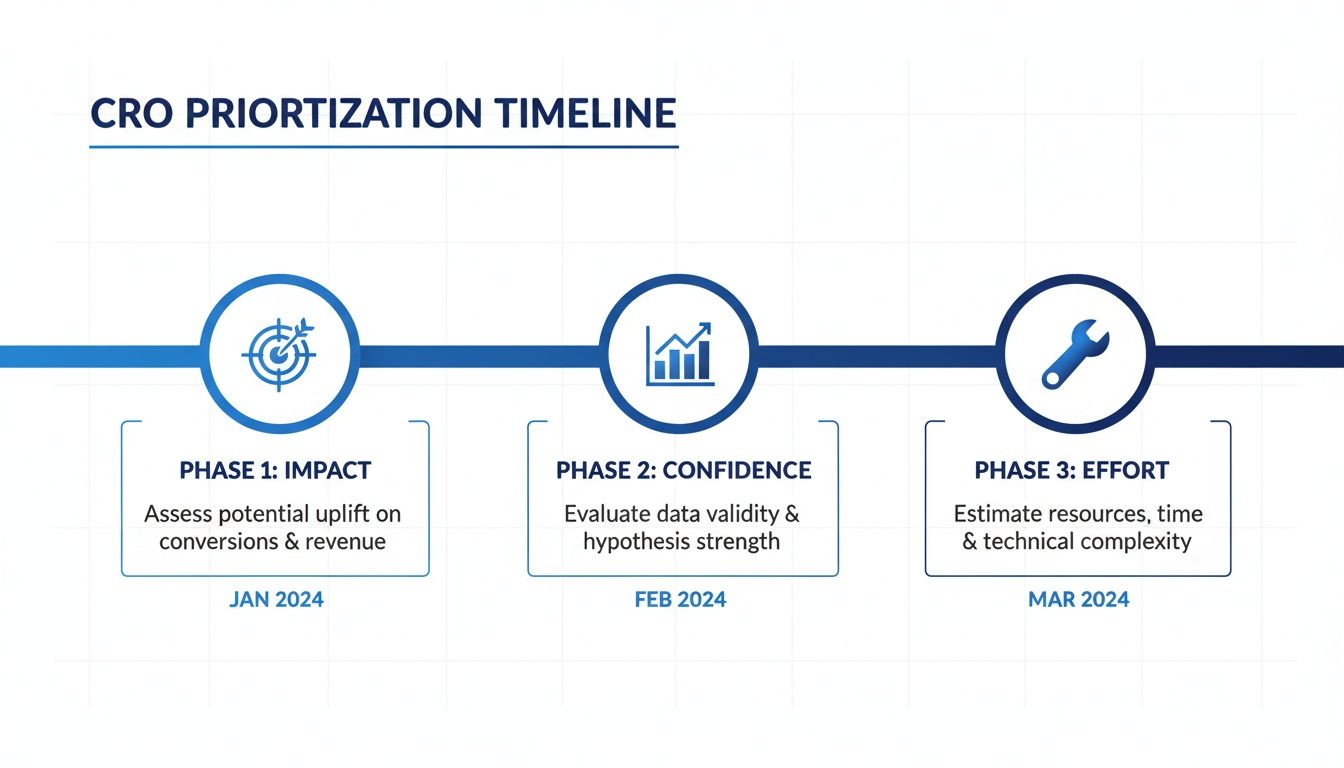
This kind of timeline brings structure to your strategy, showing how you move from evaluating an idea's potential Impact, to building data-backed Confidence, and finally to weighing the Effort required.
Phase 3: Analysis, Learning, and Scaling Success (Days 61-90)
The final 30 days are all about learning from your experiments and scaling what works. As your A/B tests wrap up, you'll have a mix of winners and losers—and both are incredibly valuable. A winning test gives you a proven change you can confidently roll out across your site for a direct impact on your bottom line.
A losing test isn’t a failure; it’s a lesson. It tells you what your customers don't want, which is just as important as knowing what they do. This insight helps you avoid costly mistakes and sharpen your future hypotheses.
In this phase, you make the winning changes permanent and document everything you've learned. The insights you gain here become the foundation for your next 90-day cycle, creating a powerful loop of continuous improvement. This is exactly how a structured program like the Optise Shopify CRO Sprint builds on itself to drive compounding growth over time.
To bring it all together, here's what a 90-day roadmap might look like in practice. This table outlines the key activities and goals for each phase of a structured CRO sprint.
Sample 90-Day Shopify CRO Roadmap
Phase | Duration | Primary Focus | Key Deliverable |
|---|---|---|---|
Phase 1: Foundation | Days 1-30 | Full-funnel audit, user behavior analysis, and technical review. | A prioritized backlog of data-backed CRO opportunities. |
Phase 2: Experimentation | Days 31-60 | Design, develop, and launch high-impact A/B tests. | Live experiments running on key pages (e.g., PDP, cart, checkout). |
Phase 3: Analysis & Scaling | Days 61-90 | Conclude tests, analyze results, and implement winning variations. | A final report with key learnings and a plan for the next optimization cycle. |
This roadmap provides a clear, logical progression, turning the abstract goal of "improving conversions" into a series of concrete steps with measurable outcomes.
Ready to Fast-Track Your Growth? Meet the Optise Shopify CRO Sprint
Let's be honest—building a top-tier conversion rate optimization strategy takes a unique mix of skill, data-crunching, and serious dedication. You've just walked through the entire playbook: the audit, the prioritization, the relentless testing. You know the path to growth.
But what if you could skip the learning curve and jump straight to the results?
This is where the theory we've discussed gets real. While the framework is solid, executing it perfectly demands time and experience. For Shopify store owners who are serious about getting measurable wins without months of trial and error, there’s a much more direct route.
From a Plan on Paper to Money in the Bank
The Optise Shopify CRO Sprint is our done-for-you service designed to implement everything in this guide within a focused, 90-day period. This isn't just another checklist. It’s a complete optimization engine, built from the ground up for ambitious Shopify brands just like yours. We take care of the entire process, from a no-stone-unturned audit to launching and analyzing the experiments that actually move the needle.
Our sprint model is all about speed and impact. We cut out the slow, clunky agency onboarding and get right to work on what matters: finding the conversion killers in your customer journey and fixing them.
The point of a CRO Sprint isn't just to run a few tests. It's to build unstoppable momentum. By zeroing in on the highest-impact opportunities first, we deliver wins you can see and measure, creating a powerful foundation for compounding growth.
A Proven Process That Gets Results for Shopify Stores
This laser-focused approach has helped brands achieve massive lifts in the metrics that count. We’ve seen firsthand how a structured sprint can completely turn a store's performance around, leading to wins like an 18% increase in add-to-carts in the first 60 days alone. That’s what happens when you replace guesswork with a data-backed strategy.
Here’s what the Shopify CRO Sprint includes:
A Full-Scale CRO Audit: We dive deep into your analytics, heatmaps, session recordings, and technical setup to find every single opportunity.
A Data-Driven Roadmap: Using the ICE framework, we build a prioritized list of experiments that targets your biggest growth levers first.
Expert A/B Testing & Execution: Our team designs, builds, and launches every single A/B test, managing the entire process from start to finish.
Clear, No-Fluff Reporting: You get straightforward insights into what we’re testing, what we’re learning, and exactly how it’s impacting your bottom line.
If you’re tired of guessing and ready for real, predictable growth, the Optise Shopify CRO Sprint is your next move. It’s the complete conversion rate optimization strategy from this guide, delivered.
Got Questions About CRO Strategy? Let's Clear Things Up.
Diving into your first conversion rate optimization strategy always brings up a few questions. That's completely normal. Getting straight answers is the first step toward feeling confident enough to invest in a process that will actually grow your Shopify store. Let's tackle the big ones.
How Much Should I Budget for CRO?
This is usually the first question on everyone's mind, but there’s no single magic number. It's better to think of it as an investment rather than a cost. The real question should be, "What's the cost of not optimizing?" Every single day your store isn't performing at its peak, you're leaving money on the table and letting your ad spend go to waste.
A structured program, like a CRO Sprint, gives you a clear, fixed-cost model. You know exactly what you're investing for a period of intense, focused optimization. This approach sidesteps the open-ended retainers you see with many traditional agencies and puts your budget to work on getting real results in a set timeframe, like 90 days.
How Long Does It Take to See Results?
Everyone wants to see a change overnight. While you can definitely get some quick wins from low-hanging fruit in the first 30 days, the real, meaningful results from a proper conversion rate optimization strategy start to show up around the 60-90 day mark. This gives us enough time to do a thorough audit, form solid hypotheses, and run A/B tests long enough to get data that actually means something.
Real optimization isn't about one-off flukes or trying to go viral. It's about methodical, compounding growth. We're building a system that delivers sustainable improvements, not just a temporary spike in sales.
Patience is probably the hardest part, but it's critical. If you rush the process, you end up making decisions on bad data, and that's no better than just guessing. A disciplined 90-day sprint really hits that sweet spot for seeing a tangible impact on the metrics that matter most.
Is CRO a One-Time Project or an Ongoing Process?
Think of CRO as a continuous cycle of improvement, not a one-and-done project. Your customers' habits change, new trends pop up, and competitors are always breathing down your neck. The insights you get from one successful test become the starting point for the next one, creating this amazing feedback loop of learning and growth.
That said, you don't have to be locked into some endless contract to get the benefits. An intense, fixed-term engagement like the Optise Shopify CRO Sprint is designed to give you a massive upfront boost and leave you with a prioritized roadmap for what to do next. It’s the best of both worlds: you get immediate results and a clear path forward. The brands that truly kill it are the ones who treat CRO as a core part of their business, always refining the customer experience to unlock more revenue.
If you're ready to stop guessing and start building a data-driven strategy that delivers measurable growth, Optise can help. The Shopify CRO Sprint is built to fast-track your results in just 90 days. Book a free strategy call to see how we can help grow your store.
Article created using Outrank