Your Guide to the Conversion Rate Optimization Audit

Updated: Dec 16, 2025
Think of a CRO audit as a deep-tissue diagnosis for your Shopify store. It’s a methodical process where we dig into your website to figure out exactly why visitors are leaving without buying. We're not just guessing; we're using hard data to find the specific friction points that are quietly killing your sales.
This isn't about guesswork or blindly following trends. It's a systematic investigation designed to produce a clear, prioritized roadmap of high-impact changes that will increase your revenue.
Why Your Shopify Store Is Leaking Money
Picture your Shopify store as a brick-and-mortar boutique. You've invested heavily in marketing to get a crowd of shoppers through the door. But once inside, the layout is confusing, the price tags are hard to read, and the checkout line is a nightmare. Frustrated, people who were ready to buy just turn around and walk out.
This is precisely what’s happening on your website every single day.
These small points of friction create dozens of tiny "leaks" in your sales funnel. It's not one big, obvious problem; it's a slow drip of lost revenue from a series of small, fixable issues. Every visitor who leaves is a lost sale, wasted ad spend, and a missed chance to grow your business.
To help you visualize what a comprehensive audit covers, here's a breakdown of its core components.
The Core Pillars of a Shopify CRO Audit
Audit Pillar | What It Investigates | Primary Goal |
|---|---|---|
Quantitative Analysis | Google Analytics, Shopify data, and user funnels. | To identify where users are dropping off and pinpoint high-exit pages. |
Qualitative Analysis | Session recordings, heatmaps, and user surveys. | To understand why users are leaving by observing their actual behavior. |
Heuristic & UX Analysis | Navigation, site speed, mobile experience, and information architecture. | To find usability issues and friction points that disrupt the user journey. |
Checkout Funnel Audit | Cart page, checkout steps, payment options, and trust signals. | To eliminate barriers in the final, most critical stage of the buying process. |
AOV & LTV Levers | Upsells, cross-sells, bundling, and subscription offers. | To identify opportunities for increasing the value of each transaction. |
Each pillar provides a different lens through which we view your store's performance, giving us a complete picture of what needs to be fixed.
The Real Cost of a Low Conversion Rate
Most online stores are losing far more revenue than they realize. The average ecommerce conversion rate hovers around a surprisingly low 2.9%. Let that sink in: for every 100 visitors you pay to bring to your site, 97 of them leave empty-handed.
This is where a conversion rate optimization audit becomes so critical. It uncovers the hidden opportunities you're missing. If you want to dig deeper, you can explore various strategies to improve ecommerce conversion rate and plug revenue leaks.
A CRO audit isn't about a massive, expensive website redesign. It's about making precise, data-driven tweaks that create a smoother path from browsing to buying—turning more of the traffic you already have into paying customers.
Finding the Leaks with a CRO Audit
A CRO audit is the diagnostic tool we use to find and patch these costly leaks. We move beyond just looking at numbers and start answering the truly important questions about your store's performance:
Where are users dropping off? We find the exact pages and steps in the journey where people get stuck and give up.
Why are they leaving? By watching actual user sessions and analyzing heatmaps, we get to the "why" behind the drop-offs. It could be a confusing form, a broken link, or an unclear value proposition.
What's stopping them from buying? The audit reveals the specific roadblocks, whether it's confusing navigation, slow page loads, or a lack of trust signals right when they’re about to pull out their credit card.
This methodical approach turns a vague problem like "low conversions" into a clear, prioritized list of fixes. By plugging these leaks, you don’t just boost your sales—you build a more efficient, profitable business and create an experience that keeps customers coming back.
Our Step-By-Step CRO Audit Process
A proper CRO audit isn't a quick glance at your numbers. It’s a full-blown investigation, like a detective meticulously combing a crime scene for clues. We don't just show up and point out the obvious; we gather forensic evidence from your analytics, "interview witnesses" by watching user session replays, and reconstruct the entire sequence of events. The goal isn't just to see what happened, but to uncover exactly why your visitors aren't converting.
We go way beyond surface-level metrics to build a complete, 360-degree view of your customer's journey. This methodical approach means our recommendations are never based on guesswork. They're built on a solid foundation of hard data and real human behavior.
This is how we break it down.
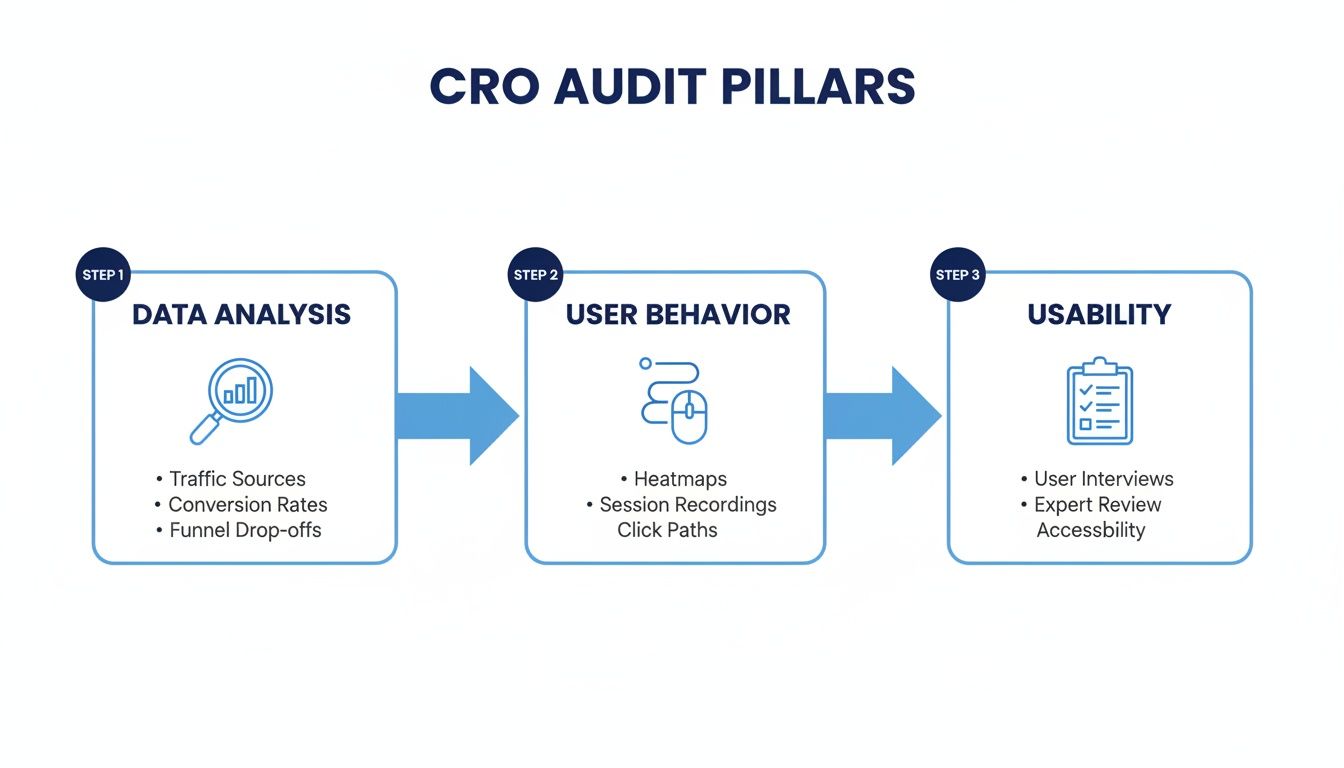
The real magic happens when you combine the hard numbers with the human story. That's where the game-changing insights are found.
Stage 1: The Data Deep Dive (Quantitative Analysis)
First things first, we follow the money. We jump straight into your quantitative data—your Google Analytics and Shopify analytics—to find out exactly where your store is leaking revenue. This is the "what" phase of the investigation. The numbers give us a treasure map, showing us exactly where the biggest problems are buried.
We’re hunting for the most significant drop-off points, asking questions like:
Collection Page Leaks: Are people browsing your products but bailing before they even click to see the details?
Funnel Black Holes: Where are users vanishing between the product page, the cart, and the checkout?
Mobile vs. Desktop Divide: Is your conversion rate taking a nosedive on mobile devices?
Stage 2: Watching Real Users (Qualitative Analysis)
Once we know what’s happening, we need to find out why. This is where qualitative analysis comes in, and it's my favorite part of the process. Using tools like heatmaps and session recordings, we can watch anonymous users interact with your site in real-time. It's like having a one-way mirror into their shopping experience.
This is where the numbers come to life. We might see someone rage-clicking a broken button, endlessly scrolling past a crucial selling point, or desperately searching for shipping info before giving up in frustration.
Watching session recordings is often the most eye-opening part of an audit. You quickly see how a small design flaw or a confusing bit of text can cause a visitor to abandon their purchase, something raw analytics data could never tell you.
For a Shopify store, this could be watching a customer add three items to their cart, sail through to the checkout, and then slam on the brakes when they're hit with an unexpected shipping fee. That insight is pure gold. It tells us the problem isn't your products—it's the experience you're delivering at the most critical moment.
Stage 3: The Expert Walkthrough (Heuristic Evaluation)
With the "what" and the "why" in hand, our Shopify experts perform a heuristic evaluation. Think of this as a rigorous, top-to-bottom inspection of your entire store, from the homepage all the way to the post-purchase thank you page. We evaluate your site against a checklist of proven usability principles, hunting for common conversion killers that often hide in plain sight.
This expert review catches friction points that data and session replays can sometimes miss. We're looking at things like:
Clarity: Is your value proposition crystal clear the second someone lands on your site? Are product descriptions compelling and easy to scan?
Friction: Are there clunky, unnecessary steps in your checkout? Is the navigation a confusing maze?
Trust & Credibility: Are trust signals like security badges, reviews, and a clear return policy easy to find? These are crucial for calming the nerves of hesitant buyers.
Drawing on our experience from optimizing hundreds of Shopify stores, this walkthrough adds a critical layer of context to everything we've learned so far.
Stage 4: The Technical Health Check (Performance Review)
Finally, none of this matters if your site is slow, buggy, or broken. A one-second delay in page load time can slash conversions by 7%. A frustrating technical glitch can sour a customer's experience instantly.
We conduct a thorough technical performance review to make sure your site's foundation is solid. This includes checking site speed, ensuring flawless mobile responsiveness, and digging for console errors or broken elements that sabotage the shopping experience.
Sometimes, the biggest wins are technical. Fixing a slow-loading product image or a broken "Add to Cart" button on a specific browser can deliver an immediate and massive boost to your bottom line. This final step ensures your store is not just persuasive and user-friendly, but also fast and reliable.
Finding Quick Wins in Your Shopify Store
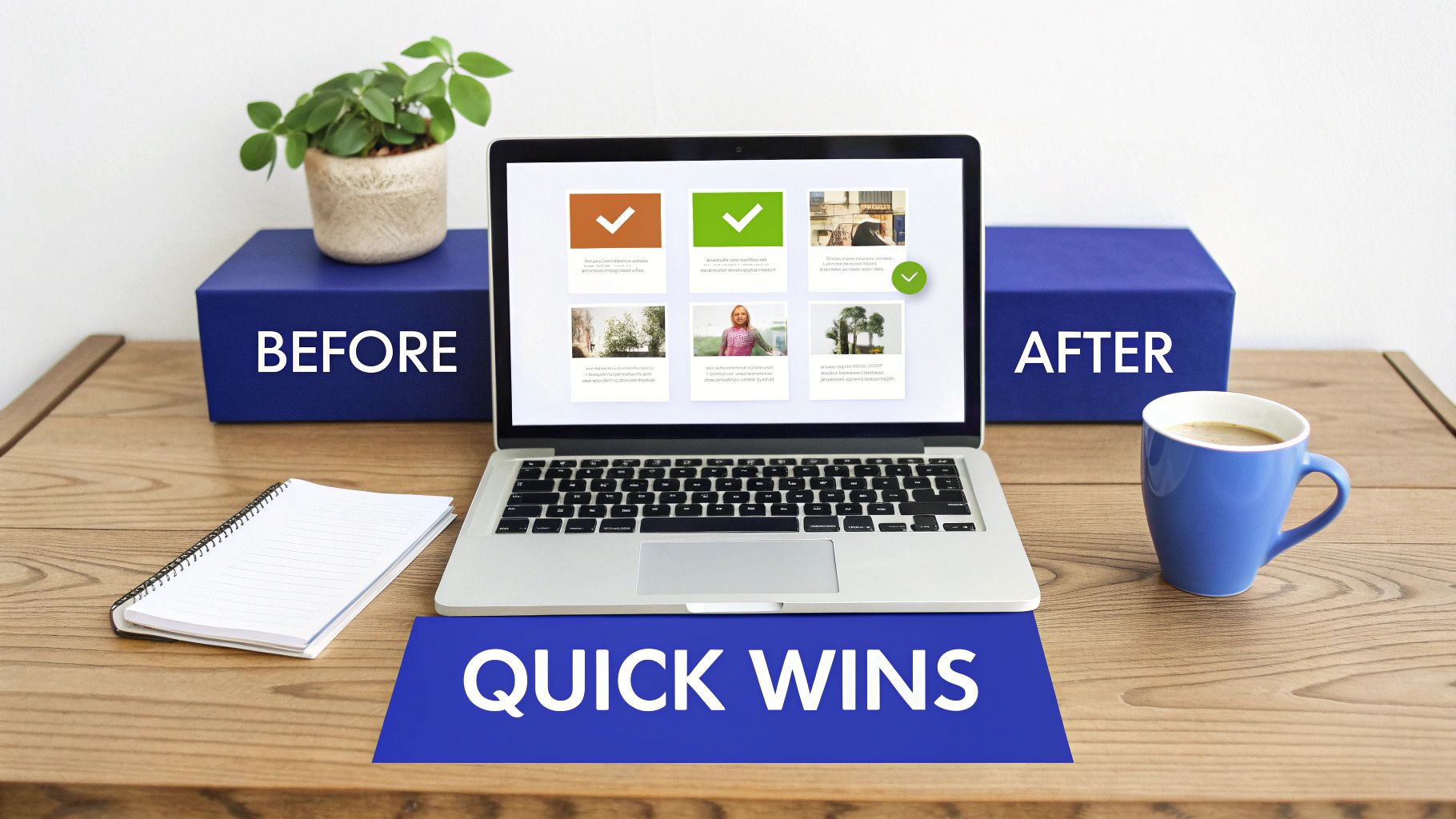
After all the deep diagnostic work of a conversion rate optimization audit, we get to the exciting part—hunting for low-hanging fruit. These are the "quick wins," those high-impact fixes that can give your sales an immediate shot in the arm without a six-month development project. Think of it like a mechanic finding a loose hose that was crippling your car's performance; a simple twist of a clamp, and suddenly everything runs better.
These quick wins are often hiding in plain sight, causing friction you’ve probably become blind to over time. They are the small hinges that swing big doors. The goal of our Shopify CRO Sprint is to spot these opportunities and pounce on them, turning insights from the audit into real, tangible revenue growth, and fast.
Let's walk through a few of the most common quick wins we uncover during our Shopify CRO Sprints.
Streamlining a Confusing Navigation Menu
Picture this: a visitor lands on your store, credit card in hand, looking for a specific product. But they’re met with a navigation menu with ten top-level categories, each hiding another eight sub-categories. Overwhelmed, they can’t find what they want in a few seconds. So they leave.
This is choice paralysis, and it's a silent conversion killer.
One of the most common quick wins is simply cleaning up the navigation. We often find menus that have become a tangled mess over time as new products and collections were added without any real strategy.
Before: The navigation is cluttered with vague labels like "Shop," "Collections," and "New Arrivals," forcing users to guess where to click.
After: We consolidate categories into clear, intuitive groups like "Living Room Furniture," "Bedroom," and "Outdoor," with logical sub-categories. This instantly reduces the mental effort required and guides the user straight to what they’re looking for.
This isn't just about making things look pretty; it's about clearing a path to purchase. Many of the best quick wins come from smoothing out the user journey. If you want to dive deeper, there are some great strategies in this guide on product page optimization for higher conversions.
Bolstering Trust at Critical Moments
Imagine a customer on your cart page, just one click away from checkout. Suddenly, doubt creeps in. “Is this site secure? What if I need to return this? Can I really trust them with my credit card?” They hesitate, can't find the answers they need, and abandon their cart.
Building trust is everything, especially for shoppers who are new to your brand. A lack of trust signals is one of the easiest and most impactful problems to fix.
An audit almost always reveals that trust signals are missing right where they matter most—on product, cart, and checkout pages. Simply adding a security badge or a money-back guarantee icon can be enough to push a hesitant buyer over the finish line.
Quick wins here often include:
Adding secure payment logos (Visa, Mastercard, PayPal) directly below the "Proceed to Checkout" button.
Placing a "30-Day Money-Back Guarantee" or "Free & Easy Returns" icon prominently on the cart page.
Displaying customer reviews and star ratings right on product pages to provide that crucial social proof.
One of the most potent forms of social proof is user-generated content (UGC). The data is compelling: sites featuring UGC see a 3.2% conversion rate, which jumps by another 3.8% when users interact with it. In fact, engagement with UGC can double the likelihood of a purchase, boosting rates by an incredible 102%.
Eliminating Sticker Shock at Checkout
Here's a scenario that gives every Shopify owner nightmares. A customer finds a product, loves it, adds it to their cart, and starts to check out. Then, on the final payment screen, they get hit with a totally unexpected, high shipping fee. That $50 purchase just jumped to $65. Feeling tricked, they close the tab in frustration.
This is the number one reason for cart abandonment—surprise costs.
A game-changing quick win is to be completely transparent about shipping costs upfront. It builds trust and manages expectations right from the start. A simple fix could be adding a shipping calculator to the cart page or displaying a clear message in a site-wide banner, like "Free Shipping on All Orders Over $75." This one small change prevents that last-minute sticker shock and can dramatically reduce how many people bail at checkout.
So, How Do You Know If the Audit Actually Worked?
A CRO audit isn't just about finding problems; it's about making you more money. Simple as that. This isn't some theoretical project to create a nice-looking report. It’s a direct investment in your store's growth, and you should expect a real, measurable return.
To make sure that happens, we skip the fluffy "vanity metrics" and zoom in on the numbers that actually drive your Shopify store's profitability.
While everyone talks about the overall conversion rate, that’s just the tip of the iceberg. The real wins come from improving a few key moments in the customer journey. Think of them as small hinges that swing big doors. When you fix these critical steps, the impact on your revenue is massive. Every single recommendation we make is designed to push these numbers in the right direction.
The Metrics That Truly Matter
Our Shopify CRO Sprints are all about moving the needle where it counts. We’re not focused on getting you more traffic; we’re obsessed with getting more value from the traffic you already have.
These are the core metrics that give us a crystal-clear picture of your store's health.
An audit’s success isn’t measured by how many things we find to fix. It’s measured by the cash it puts back into your business. We track these specific metrics to prove the ROI, turning our insights directly into dollars.
Let's break down the vital signs of your store. Each one tells a crucial part of your customer's story, revealing exactly where the friction is—and where the opportunity lies.
Shopify CRO Audit Metric Breakdown
The table below explains what each key metric measures and, more importantly, what it tells you about your store's performance.
Metric | What It Measures | Why It's Critical for Your Store |
|---|---|---|
Cart Abandonment Rate | The percentage of shoppers who add items to their cart but leave before starting the checkout process. | A high rate here often signals issues with trust, product information clarity, or a confusing user experience on the cart page itself. Fixing these leaks can be a huge quick win. |
Checkout Abandonment Rate | The percentage of shoppers who begin the checkout process but abandon it before completing their purchase. | This is the final, most critical hurdle. High abandonment here is almost always caused by surprise shipping costs, a complicated form, or a lack of payment options. |
Average Order Value (AOV) | The average dollar amount spent each time a customer places an order on your website. | Increasing AOV means you're making more money from each customer. The audit identifies opportunities for strategic upsells, cross-sells, and product bundles. |
Revenue Per Visitor (RPV) | The average amount of revenue generated from each unique visitor to your store, whether they buy or not. | RPV is the ultimate health metric. It combines your conversion rate and AOV, giving you a clear indicator of how efficiently your store turns visitors into revenue. |
Think of these metrics as your store's diagnostic panel. When one of them is flashing red, we know exactly where to look.
From Small Tweaks to Serious Growth
This is where it all comes together. A tiny 0.2% drop in checkout abandonment might not sound like a big deal, right? But for a store doing $50,000 a month, that one small fix can add thousands of dollars to your bottom line over a year.
What about a $5 increase in AOV from a well-placed post-purchase offer? That can completely change the game for your store, improving profitability and making your ad spend far more effective.
Our entire audit process is built to find and exploit these high-leverage opportunities. By methodically improving each of these core metrics, we create a powerful compounding effect. A slightly lower cart abandonment rate, plus a higher AOV, plus a smoother checkout... it all adds up to a major lift in your total revenue—without you spending a single extra dollar on ads.
Should You DIY Your Audit or Call in the Pros?
You've seen the leaks. You know your Shopify store could be making more money. Now you’re at a crossroads: Do you roll up your sleeves and try to fix the conversion issues yourself, or do you bring in a specialized crew to get the job done right—and fast?
This isn't just about saving a few bucks. It's a strategic choice about what you value more: your time, your money, or the speed at which you start seeing real growth. Let's walk through what each path actually looks like.
The "Do-It-Yourself" Audit: A Founder's Gamble
The DIY route has a certain appeal, doesn't it? The biggest draw is the perceived cost: zero. For a founder watching every dollar, this feels like the smart, scrappy thing to do. You’ll learn a new skill, get your hands dirty in the data, and keep total control.
But here’s the honest truth: the DIY path is rarely free. It just asks you to pay with a different currency—your time, your focus, and your own sanity. The real costs are hidden.
The Brutal Learning Curve: Getting good with tools like Google Analytics 4, let alone session replay software like Hotjar, isn't a weekend project. You're looking at dozens of hours just to learn the ropes, and many more to get to a point where you can trust your own interpretations.
The Danger of Misreading the Signs: Data without experience can be misleading. It’s all too easy to spot a high bounce rate on a page, declare it a disaster, and spend weeks "fixing" a problem that wasn't the real issue. This is how stores waste entire quarters on changes that move the needle by 0%.
The Sheer Time Sink: A proper, deep-dive conversion rate optimization audit isn't a quick task you knock out on a Friday afternoon. We're talking 40-60 hours of focused, uninterrupted work. For a founder, that’s time ripped away from marketing, product sourcing, or customer service—the things that only you can do.
The DIY path feels free upfront, but you pay for it with your most precious resource: time. The real cost isn't in dollars; it's in the months of lost sales you could have been making while you were busy trying to become a CRO expert overnight.
The Optise Shopify CRO Sprint: The Fast Track to Revenue
Now, let's look at the alternative. Our Shopify CRO Sprint isn't just an audit—it’s a full-service optimization program built for one thing: getting you results, fast.
Think of it like this: You could watch YouTube videos to figure out why your car's engine is making a funny noise. Or you could hand the keys to a master mechanic who can diagnose it in minutes and have it running perfectly by the afternoon. Both might work, but only one is fast, reliable, and guaranteed.
Here’s what our CRO Sprint delivers that a DIY approach just can't.
Expertise, Speed, and a Fresh Perspective
We’ve Seen This Before: We've been under the hood of hundreds of Shopify stores. We spot the common conversion killers instantly because we’ve seen them—and fixed them—time and time again. We skip the learning curve and get straight to the solutions.
Pro-Grade Tools: We come armed with a suite of premium CRO tools that would cost a single store thousands of dollars a month to license. This gives us a much deeper, more accurate picture of what's really happening, leading to far better insights.
The "Outsider" Advantage: You’re too close to your own store. You see it every single day, and that creates blind spots. We come in with fresh eyes, seeing your store exactly as a new customer would, and we immediately spot the friction points you've stopped noticing.
From Audit to Action, Fast: This is the biggest difference. A DIY audit can drag on for a month or more, with implementation taking even longer. Our sprint is designed to deliver a prioritized, high-impact roadmap in just a couple of weeks, so you can start shipping changes and seeing a lift in your numbers right away.
So, the choice becomes much clearer. If you have endless time and a high tolerance for trial-and-error, a DIY audit can be a great learning experience.
But if your goal is to grow your revenue as quickly and predictably as possible, our sprint is the most direct path to get you there.
What You Get with an Optise CRO Sprint
So, you’ve decided it’s time to call in the experts. Great call. But what does that actually mean? Our Shopify CRO Sprint is designed to be a complete, end-to-end growth system that moves from audit to implementation at speed.
When you work with us, you’re not just getting a one-off audit. You’re getting a nimble, focused sprint built to turn powerful insights into real revenue. This isn't a six-month consulting engagement; it's a fixed-scope, fixed-price project designed to deliver a clear ROI.
A Clear Roadmap to Higher Conversions
From the moment we kick things off, you’ll receive a set of crystal-clear, actionable deliverables. Forget vague recommendations and consultant-speak; we give you a concrete plan for growth.
Here’s what’s included in your sprint package:
Comprehensive Audit Report: We hand you a detailed report that breaks down everything we found during our deep-dive analysis. It pinpoints the exact friction points that are costing you sales right now.
Prioritized Recommendations: We don't just dump a list of problems in your lap. We give you a prioritized action plan that zeroes in on the quick wins and high-impact changes that will make the biggest difference, fastest.
Implementation Roadmap: This is your step-by-step guide. It clearly outlines what needs to be done, who’s doing it, and when it will get done. No ambiguity.
Visual Mockups: For the most important changes, we create visual mockups and wireframes. This way, you can see exactly how the improvements will look and feel on your site before a developer ever touches a line of code.
We want to answer the big question: 'If I sign up, what do I actually get?' Our entire process is built to give you total confidence and clarity, making the decision to grow your business an easy one.
The Sprint Timeline in Action
Speed is our secret weapon. A traditional agency might take months to get to where we are in just a few weeks. Our sprint model is all about building and maintaining momentum, moving from analysis to action without delay.
Here’s a look at a typical four-week sprint:
Week 1 - Analysis & Discovery: We jump straight into the full conversion rate optimization audit. We’re digging through your analytics, watching session replays, and mapping out the user experience to uncover those golden opportunities.
Week 2 - Strategy & Roadmap: We present our findings and deliver the prioritized roadmap. Together, we’ll align on the strategy and lock in the plan for the highest-impact tests.
Weeks 3-4 - Implementation & Testing: Our team gets to work. We start building the changes and launching A/B tests to prove our hypotheses with real data from your customers.
This isn’t just about auditing your store—it’s about actively improving it from the very first week. You can get all the details on how we transform Shopify stores by checking out our Shopify CRO Sprint. Our mission is to make expert-level optimization accessible, fast, and incredibly effective, turning your store into the conversion machine it was always meant to be.
Common Questions We Hear from Shopify Founders
Taking the plunge on a professional conversion rate optimization audit is a big decision. It’s smart to have questions, and we’re all about transparency. Here are the most common things we discuss with Shopify store owners before they get started.
How Much Does a CRO Audit and Sprint Cost?
We always reframe this question. Instead of thinking about cost, think about Return on Investment (ROI). Our sprint isn't just an expense; it's a direct investment designed to plug revenue leaks and generate more sales from the traffic you already have.
Our Shopify CRO Sprint is a fixed-price package, so you know the exact cost upfront. It's built to deliver a clear financial return, quickly paying for itself and becoming a growth engine for your store.
How Quickly Will I See Results?
Our sprint model is designed for momentum. While a full optimization strategy creates compounding gains over months and years, our first priority is always the "quick wins."
These are the high-impact, low-effort fixes that can create a measurable lift in just a few weeks. You'll see immediate improvements from fixing glaring issues while we build out the roadmap for sustained, long-term growth.
Is This Right for My Unique Shopify Store?
One hundred percent. We don't do cookie-cutter audits. Your store has a unique audience, a specific product mix, and its own brand voice. That’s why our entire process is built from the ground up around your business.
We dive deep into your analytics and watch your customer sessions to find your biggest opportunities. The recommendations you get will feel like they were made for your store—because they were.
What Tools Do You Use for the Audit?
You don’t have to worry about a thing; we bring the entire diagnostic toolkit with us. Our team uses a suite of professional-grade tools for analytics, session replays, and A/B testing—software that would be expensive and time-consuming for you to manage alone.
There are no new subscriptions to buy or platforms to learn. We handle all the tech, so you can focus on the results.
Ready to stop guessing and start growing with data? Optise provides a clear, data-backed roadmap to increase your Shopify sales without spending another dollar on ads.
Let's find out how our CRO Sprint can transform your store. Book a free, no-obligation strategy call today.
Article created using Outrank